Your car’s wheels don’t stay perfectly aligned forever. Road conditions, everyday wear, and even a single hard pothole strike can shift your alignment enough to affect how your vehicle handles. For drivers in North Hampton, NH, where seasonal road changes create constant challenges for suspension systems, staying on top of wheel alignment is one of the most practical things you can do for your vehicle.
New Hampshire roads are tough on tires and suspension. Frost heaves, winter damage, and uneven pavement gradually pull your alignment out of spec, often before you notice anything wrong. By the time your car starts pulling to one side or wearing through tires unevenly, the problem has already been building for a while.
At Automotive Alignments and Calibrations, we provide reliable wheel alignment in North Hampton, NH, along with the mechanical know-how to keep your vehicle handling mile after mile safely.
What Is Wheel Alignment, and Why Does It Matter?
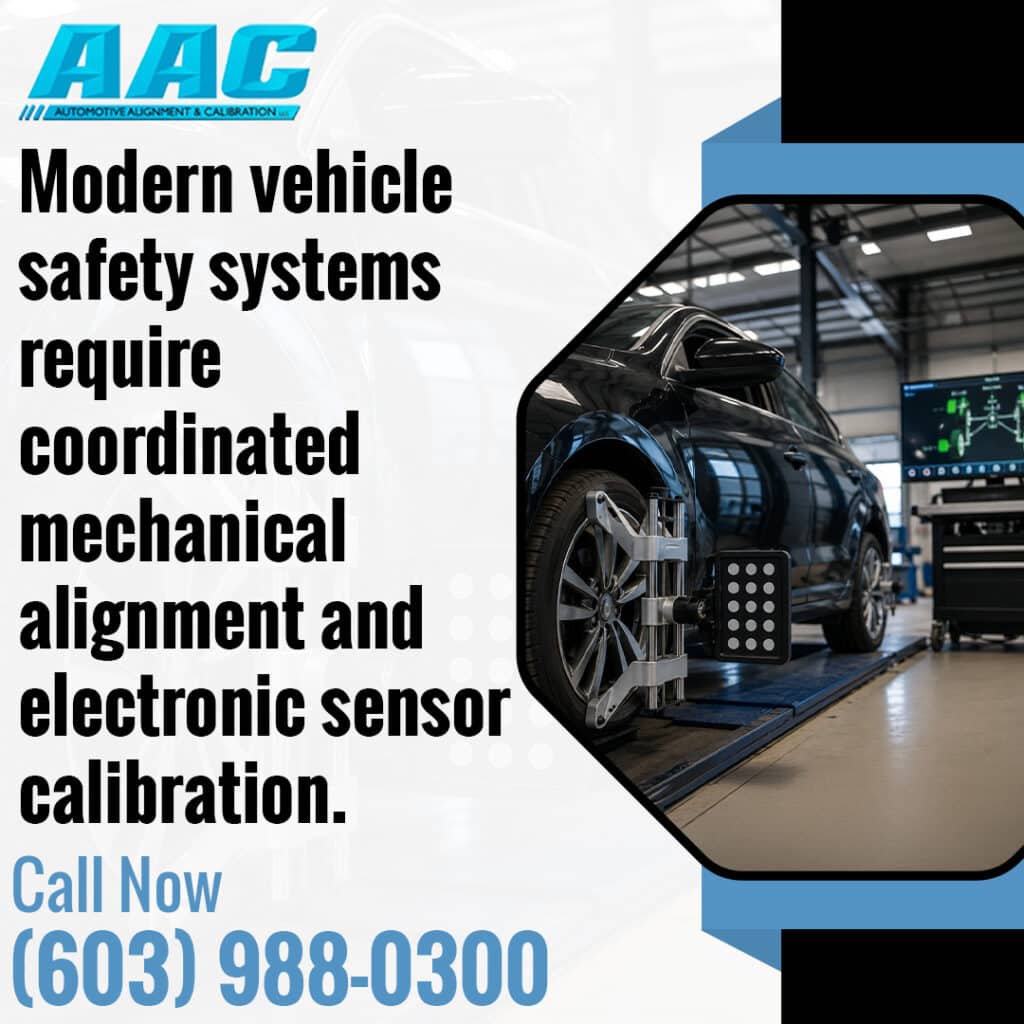
Wheel alignment is the process of adjusting your vehicle’s suspension angles so all four tires make proper, even contact with the road. The tires themselves are not what get adjusted; it is the angles at which they sit relative to the road and to each other.
Your vehicle’s manufacturer sets specific angle specifications for tire contact. Over time, road conditions and impacts push those angles out of range, leading to faster tire wear, sluggish steering, and added stress on suspension parts.
The three main alignment angles are:
- Toe: whether the front edges of the tires angle inward or outward
- Camber: the inward or outward tilt of the tire when viewed head-on
- Caster: the angle of the steering axis, which influences stability and straight-line tracking
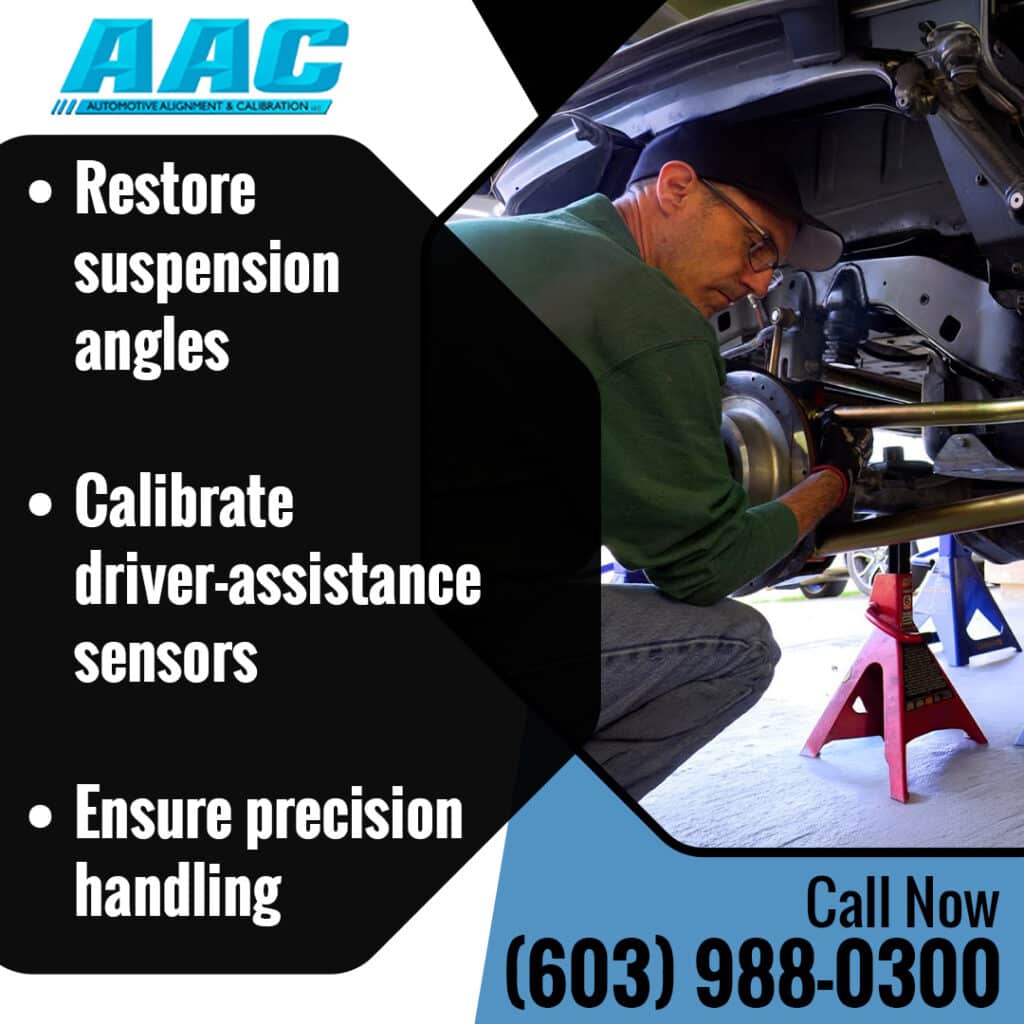
Proper alignment and calibration services correct all three angles so your vehicle tracks straight, tires wear evenly, and steering stays responsive.
Signs You Need Wheel Alignment
Misalignment often develops gradually, which makes it easy to dismiss as “just how the car drives.” There are clear signs that tell you something is off. If you notice any of the following, it is time to schedule a wheel alignment:
- Your vehicle pulls or drifts to one side on a straight, flat road
- Your steering wheel sits off-center even when driving straight
- Tires are wearing unevenly, with one edge wearing faster than the other
- Your steering feels loose, vague, or requires constant minor corrections
- You feel vibration or shuddering through the steering wheel, especially at highway speeds
- Dashboard warning lights for stability control or steering systems have turned on
None of these symptoms fix themselves. The longer they go unaddressed, the more tire tread and suspension life you lose. Our ASE-certified technician at Automotive Alignments and Calibrations can quickly identify whether misalignment is the source of these issues and correct it before it leads to bigger repairs.
What Causes Wheels to Go Out of Alignment?
Misalignment has no single cause. It can build gradually over thousands of miles or happen immediately after one hard impact. Here are the most common reasons North Hampton drivers need alignment work:
- Road conditions: Frost heaves, potholes, and cracked pavement put repeated stress on suspension geometry. Driving New Hampshire roads regularly, even at normal speeds, gradually shifts alignment angles out of specification.
- Single impacts: Hitting a pothole hard, striking a curb, or having a minor fender bender can knock alignment out of whack right away. If your steering feels different after any impact, have it checked promptly.
- Worn suspension components: Worn ball joints, tie rods, or control arm bushings allow movement in parts that should stay fixed. Our technician inspects suspension components before making any alignment adjustments.
- New tires or recent suspension work: Whenever tires or suspension components are replaced, an alignment check protects your investment and confirms everything is working as it should.
How Often Should You Get a Wheel Alignment?
Most vehicles do well with an alignment check about once a year or every 12,000 to 15,000 miles. That is a solid baseline for drivers on relatively maintained roads.
For drivers in North Hampton and nearby areas, more frequent checks often make sense. New Hampshire roads, particularly after winter, can justify checks every 6,000 to 10,000 miles, depending on where and how much you drive. Scheduling wheel alignment in North Hampton, NH, before and after winter is a practical habit that protects both your tires and suspension long-term.
Schedule an alignment check after any of the following, regardless of mileage:
- Hitting a hard pothole or curb
- Replacing one or more tires
- Any suspension repair or component replacement
- A minor collision, even if visible damage appears minimal
- Noticing pulling, drifting, or uneven tire wear between scheduled maintenance visits
Treating wheel alignment as preventive maintenance, rather than something you address only after problems appear, saves money in the long run. Replacing tires prematurely because of uneven wear costs far more than a routine alignment check.
The Connection Between Wheel Alignment and ADAS Calibration
Wheel alignment is not just a mechanical issue anymore. On most vehicles built in the last several years, it directly affects the accuracy of your safety systems.
Modern vehicles rely on Advanced Driver Assistance Systems, or ADAS, which include features drivers depend on daily:
- Lane-keeping assist
- Automatic emergency braking
- Adaptive cruise control
- Blind spot monitoring
- Rear cross-traffic alert
Every one of these systems depends on sensors and cameras calibrated to your vehicle’s specific geometry. When wheels fall out of alignment, those sensors lose their accurate reference point. The steering angle sensor reads wheel position as a proxy for vehicle direction. If alignment is off, inaccurate data flows to every safety system connected to it.
This is why our alignment and calibration services at Automotive Alignments and Calibrations address both the mechanical and electronic sides of your vehicle together.
What Is Steering Calibration?
Steering calibration is the process of resetting and verifying the steering angle sensor after alignment work or steering component repairs. It is a step that is easy to overlook but matters a great deal for how your vehicle’s safety systems function.
The steering angle sensor sits on the steering column and measures how far the steering wheel has turned from its centered position. That data is shared with your vehicle’s computer and distributed to stability control, ADAS features, and driver assistance functions. After a wheel alignment adjustment, the sensor needs a new reference baseline. Without it, your safety systems continue operating from old data, even though the wheels themselves are now correctly positioned.
It is also necessary after:
- Tie rod or steering rack replacement
- Suspension repairs affecting the toe or thrust angles
- Post-collision work involving steering components
- Airbag deployment
At Automotive Alignments and Calibrations, this service is performed using OEM scan tools and Bosch diagnostic equipment. Our technician verifies steering calibration to your vehicle manufacturer’s exact specifications, not just approximates them.
ADAS Calibration Services
ADAS calibration services in North Hampton require precise target positioning, manufacturer-specific diagnostic software, and a technician who understands how each system interacts with alignment geometry. Not every shop can perform this correctly.
At our shop, we handle both types of ADAS calibration:
Static calibration is performed inside the shop with the vehicle stationary. Reference targets are positioned at exact distances and angles per manufacturer specifications.
Dynamic calibration is performed on the road under specific driving conditions to confirm accurate sensor performance.
What to know about our calibration process:
- Procedures follow manufacturer-specific requirements for each make and model
- Some vehicles require both static and dynamic calibration
- OEM scan tools and Bosch diagnostic equipment are used throughout
We also work with Committed Collision, serving the NH Seacoast for over 20 years, to coordinate post-collision recalibrations for drivers in the area.
Why Alignment and Calibration Services Work Best Together
For most modern vehicles, alignment and calibration services are not two separate jobs. They are connected steps in the same process.
Performing an alignment without verifying whether ADAS calibration is required leaves the vehicle mechanically corrected but electronically incomplete. Equally, calibrating ADAS sensors on a vehicle still out of alignment means the calibration is built on a flawed foundation. Sensor accuracy depends on wheel positioning being correctly set before any calibration can be held.
Here is how the two connect in practice:
- A four-wheel alignment corrects the mechanical angles of the suspension
- Steering calibration resets the steering angle sensor to the vehicle’s updated geometry
- ADAS calibration confirms all cameras and sensors are working from accurate reference data
At Automotive Alignments and Calibrations, every vehicle is handled by a single ASE-certified technician from start to finish, so nothing gets missed between steps.
What to Expect During Your Alignment and Calibration Visit
Here is what the process looks like when you bring your vehicle in for wheel alignment:
- Pre-alignment inspection: Suspension components, tire pressure, and steering parts are checked before any adjustments are made.
- Four-wheel alignment measurement: Current toe, camber, and caster angles are measured against your manufacturer’s specifications.
- Adjustment to factory spec: Any angles outside specification are corrected to manufacturer-recommended settings.
- Post-alignment verification: Measurements are confirmed after adjustment before the vehicle leaves the rack.
- Steering and ADAS calibration check: Our technician determines whether steering calibration or ADAS calibration is required and completes those procedures before the job is done.
What to know about parts and pricing:
- OEM parts are used whenever possible, based on your vehicle’s needs and insurance coverage
- High-quality aftermarket parts are used when they are the right fit
- No upsells. You will know exactly what is being done and what it costs before any work begins.
Ready to Drive with Confidence? Schedule Your Service Today
Your vehicle deserves accurate, thorough care, from the mechanical angles of your suspension to the electronic systems that keep you safe on the road. At Automotive Alignments and Calibrations, every job is handled by a single ASE-certified technician using OEM scan tools and Bosch diagnostic equipment, with honest pricing and no upsells from start to finish.
Whether you need wheel alignment, steering calibration after a repair, or ADAS calibration services in North Hampton following a collision, we are here to help you get back on the road safely and confidently.
Call us at (603) 988-0300 or email us at aacofnh@gmail.com to schedule your free estimate today.